
Foundation
Trust Infrastructure
The institutional foundation for governed autonomous execution.
As autonomous systems move from generating information to making decisions and executing actions, institutions require infrastructure capable of governing not only the technology, but the authority under which it operates.
CoreIdentity defines Trust Infrastructure as the operational institutional foundation through which authority can be established, delegated, constrained, exercised, verified, and preserved throughout autonomous execution.
Delegate Execution. Never Surrender Control.
The delegation problem
Autonomous execution changes what institutions must govern.
Traditional infrastructure was designed to govern users, applications, data, transactions, and systems. Autonomous execution introduces something materially different: machines exercising delegated institutional authority.
What is the system authorized to do, on whose authority, under what conditions, within what boundaries, and how does the institution remain in control throughout execution?
This is where Trust Infrastructure begins.
Authority must travel with execution
Governance cannot remain upstream from the action.
Institutional authority and its constraints must remain connected to execution. Governance therefore has to operate through the execution lifecycle—not only through policy, approvals, or retrospective review.
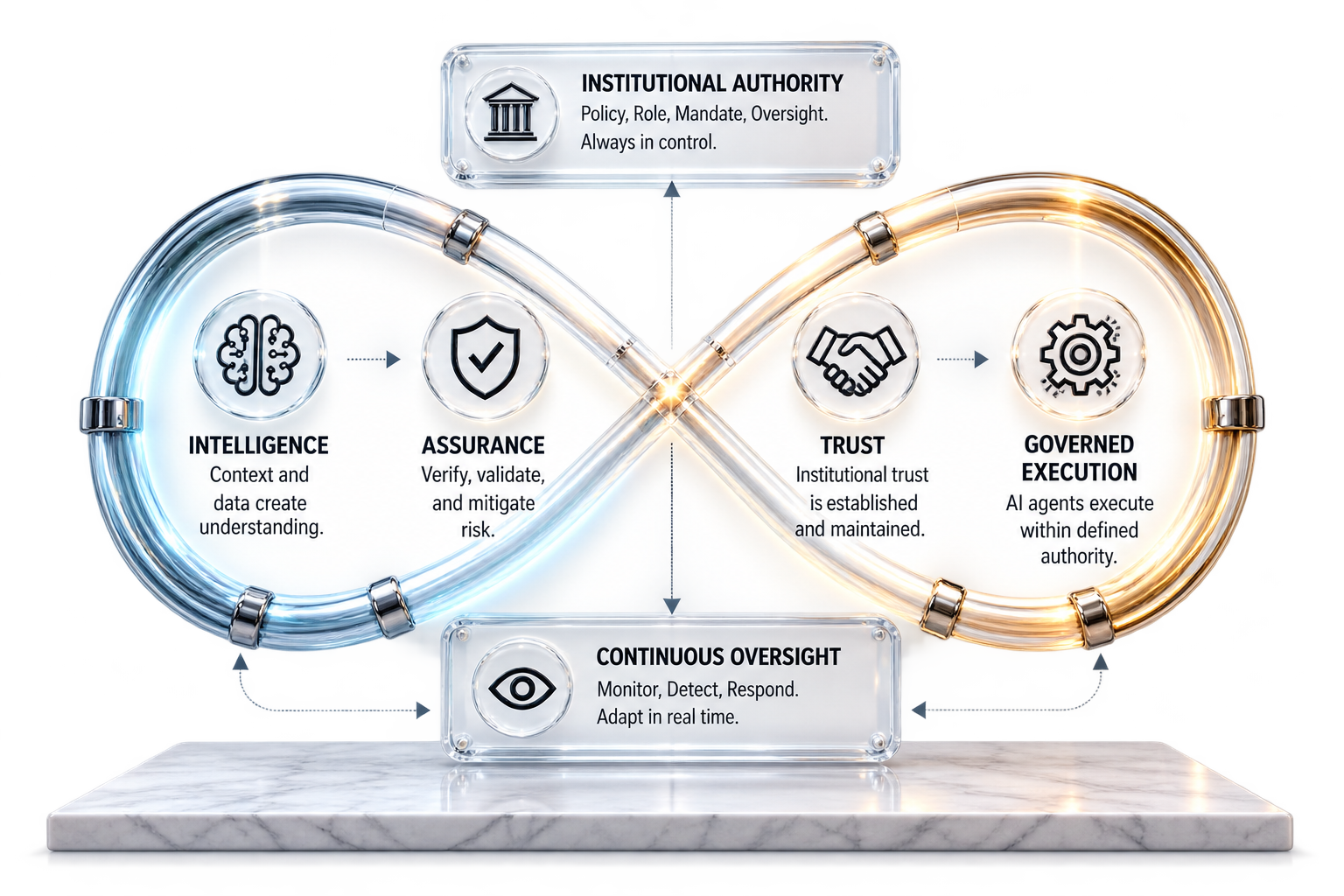
Four interconnected institutional functions
Trust Infrastructure operates through four interconnected institutional functions.
Institutional Intelligence — Establishes institutional context, identity, policy, obligations, risk, and operational awareness.
Governance — Establishes authority, determines policy, sets boundaries, and governs autonomous execution.
Institutional Assurance — Continuously verifies compliance, control, and performance so execution remains authorized and within institutional requirements.
Institutional Trust — Establishes verifiable confidence that authority, control, oversight, and accountability are maintained throughout governed execution.
Designed around institutional control
Trust Infrastructure establishes governance behavior, not a catalog of components.
- Authority
- Establish legitimate institutional authority.
- Delegation
- Define what authority autonomous systems may exercise.
- Boundaries
- Establish conditions, permissions, prohibitions, and escalation requirements.
- Enforcement
- Maintain those requirements during execution.
- Evidence
- Preserve attributable evidence of material actions.
- Accountability
- Maintain the connection between autonomous execution and responsible institutional authority.
Trust Infrastructure carries institutional governance through execution. Institutional Intelligence enables the institution to understand what is occurring within that governed environment.
Explore Institutional Intelligence →